Monday, 21 April 2014

Stephen Donelly talks of the beautiful Palace Theatre, Swansea

The Palace has been many things to many people since 1888. It's roof has provided shelter to thousands, whether as a venue for vaudeville performance, as Jingles In the 80's and a Techno/Dance club in the 90’s. As Swansea City Centre gets remapped, rebuilt and modernised into a 'European Boulevard City', The Palace's continued presence on High Street stands as an important reminder of the City's culture and the debt it owes to it's past.


In January Swansea Council reported they have had continued to ‘positive confidential discussions’ with the owners of the Palace Theatre Building. A recent feasibility report carried out on the building by the council suggested that returning it to a theatre would be unrealistic because of the structure and current safety regulations, but did suggest other uses.


As of April Swansea Council made grant funding of £75,000 available to the Palace owners to help support the urgent work to help begin urgent repair work to the building, which is a great positive step forwards after years of neglect. Lets hope this is just the first of many positive moves which lead to finding a long-term sustainable reuse for the building, and that further deterioration is stopped sooner rather than later.


https://www.facebook.com/ThePalaceTheatreSwansea

http://www.southwales-eveningpost.co.uk/Swansea-Palace-Theatre-emergency-repair-work/story-20958729-detail/story.html


Blog written kindly by Stephen Donelly from the Save the Palace Theatre

Tuesday, 15 April 2014

Tim James Visits the beautiful Gatehouse of Dunraven Castle

Throughout my trips spent tracking down abandoned buildings around Wales, I seem to have been drawn to the larger, grander buildings, but I must not forget the beauty of smaller buildings that lie in a similar state of dereliction; equally deserving to be rescued from their current state of neglect.

I have chosen two buildings at the opposite end of Wales.  They are built in different styles, but both of which had the same original use; these are two of the crumbling gate houses of Wales.
Standing in the grounds of the now demolished Dunraven Castle in Glamorgan is a beautiful crenellated gate house. It is situated a stone's throw from the coast up a rough farm track. The  castle-like design bears no resemblance to the actual castle that once stood at the centre of the Dunraven estate.  Despite this building having been out of use for many years the fabric of the building looks to be in surprisingly good shape.  It still retains all its crenellations, and, surprisingly, the roof is largely in situ.  Unlike so many building that have been out of use for a while this structure is free of saplings growing in gaps in its masonry, and this is a pleasure to see. Sadly the inside is in a rather more dilapidated state with rotten beams and stones lying scattered about the floor.  The absence of doors means that this building, intended for human habitation is now open and housing  any wildlife that wanders in.

In contrast to this is the gate house at Baron hill on Anglesey. A fine neo-Palladian building built in the same style of the mansion it once served. The gate house now is covered with ivy. The roof is long gone and so too are the ornate iron gates that once stood beside it. There is evidence that at some point an attempt has been made to keep the elements out of the building by placing corrugated sheeting over the roof. Alas this seems to have been in vain. The inside walls are in a desperate state as saplings push their way through the gaps in the stone work. The building is surrounded by a jungle of vegetation and fallen trees.  What a sad state this building is in.


Here we have two small buildings crying out for attention, both of which would make a great place for someone to live in, or as very popular holiday rentals. If only their owners would place them on the open market I'm sure they would be snapped up at once! 

-piece written by Tim James

Thursday, 6 March 2014

Tim James Explores the Amazing Marine Buildings at Penarth, Cardiff

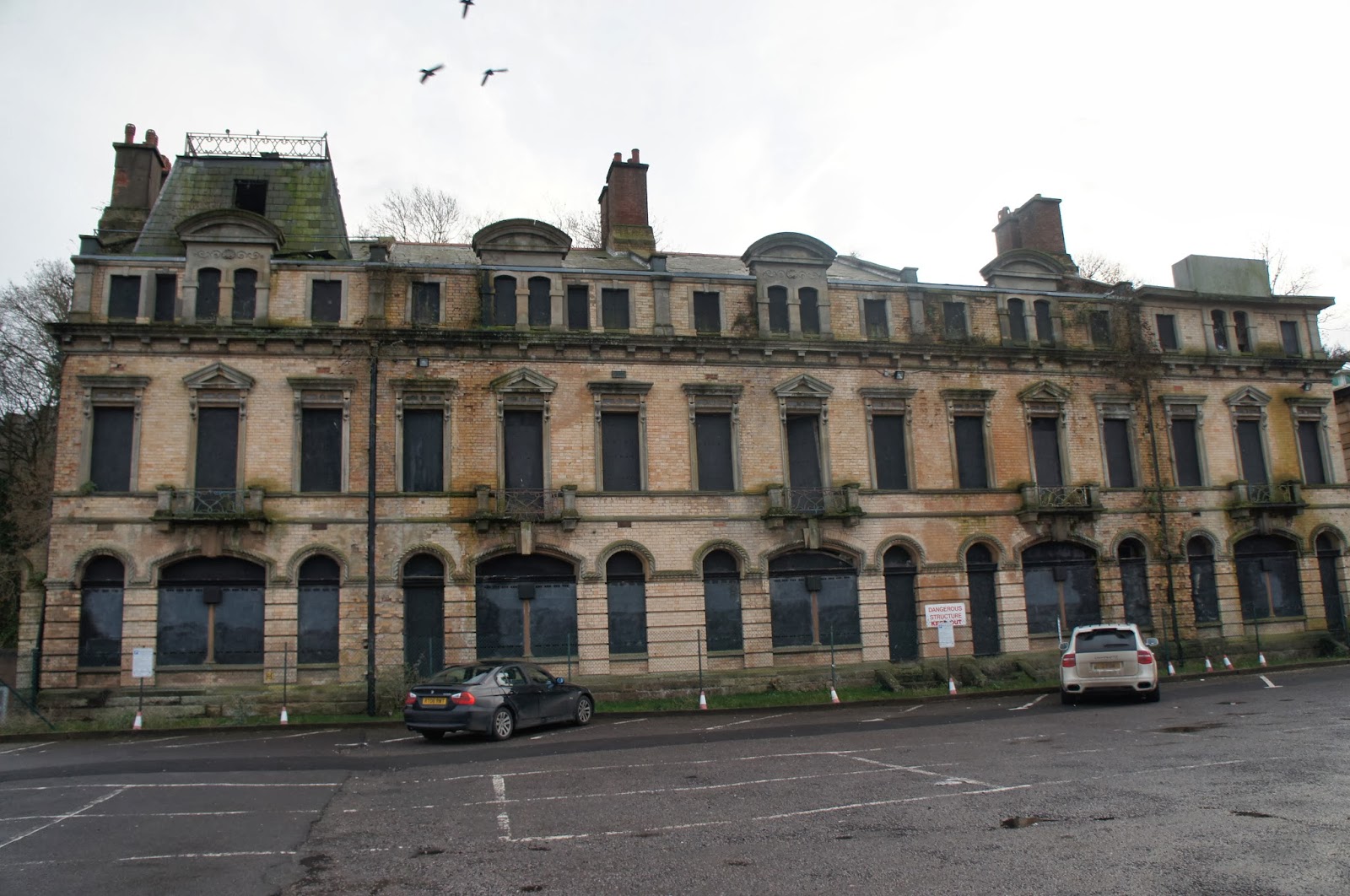
A French Renaissance landmark  located in Penarth overlooking Cardiff Bay is continuing to rot as  plans to convert it back into a hotel continue to be put on hold. The building, known as Marine Buildings, has stood empty for the past 30 years. It has been the victim of fire and continuous water damage as the roof has largely collapsed leaving the building under ever more strain from the elements. The building has now been declared structurally unsound  after many of the internal walls have collapsed.  The impressive front facade is constructed of yellow brick topped off at either end with French pavilion roofs,(one of which now has fallen in).

In 2012 the estimated cost of the redevelopment of the building stood at 6 million pounds. This would include the building of a modern extension to the side and rear as well restoring the existing buildings facade to its former grandeur, reinstating the French Renaissance elements  that give this building its distinctive look.  The four star boutique hotel would boast 55 bedrooms, a wine bar and a restaurant.

But what is actually happening?  After being bought by the current owners in 2000 it was finally granted planning permission to transform it into a hotel. In 2012 all seemed to go quiet and just a few weeks ago  the Penarth Times reported that the renovations would be on hold until 2015 at the earliest.   It  was also reported that there would be a rise in the estimated cost of restoring  the building of an extra million pounds. Marine Buildings is a Grade II listed building and deserves to be restored.  I only hope that the owner finds the necessary funds to restore or at least make safe the current structure  before another decade passes and yet more of this building falls into the basement.  


Thursday, 20 February 2014

Local Artist Ceri Leeder Reconfigures Brynkir

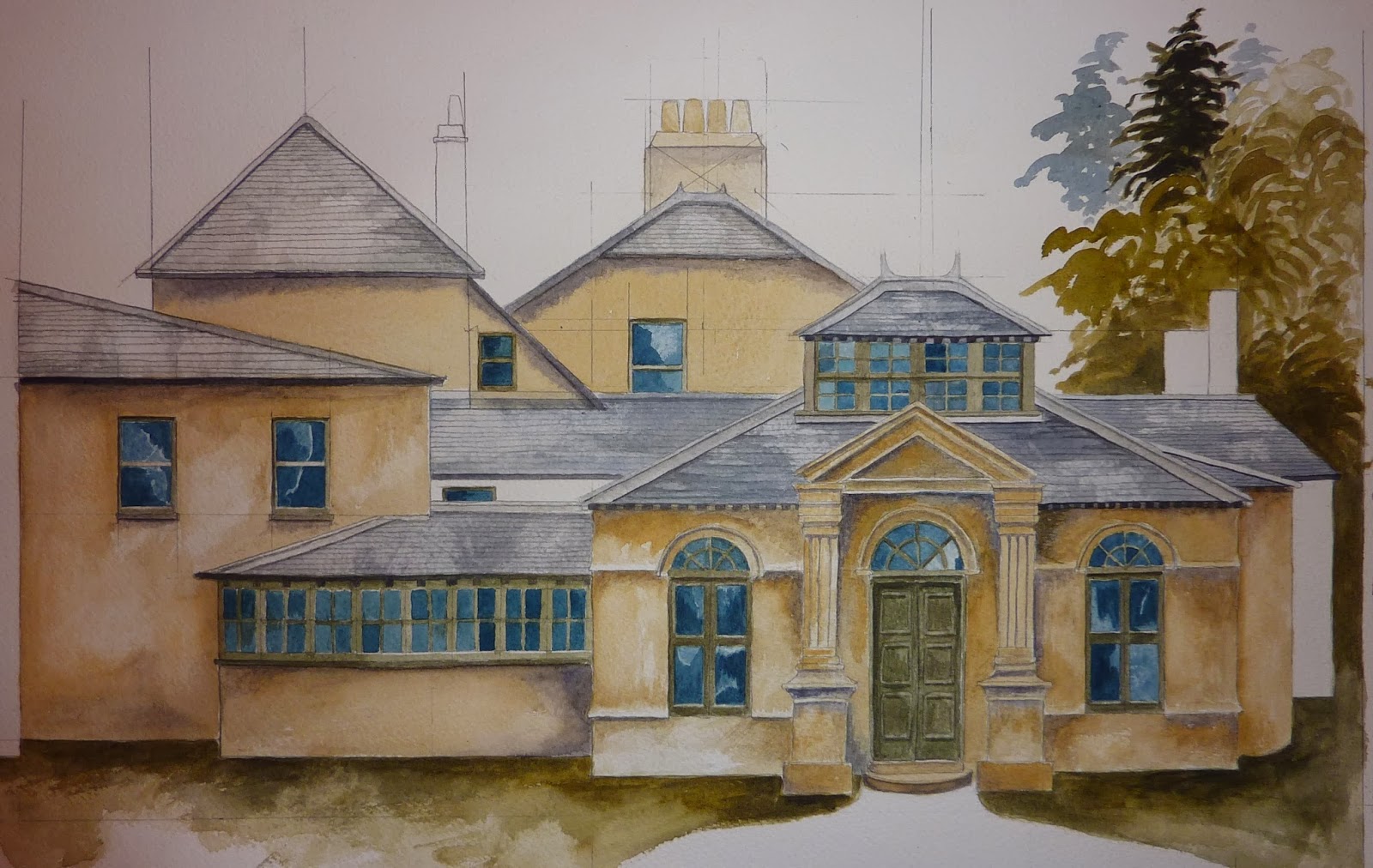
Mark and I have worked in the past on previous sites, reconstructing remains from photos, finds and maps. Brynkir had a number of old photos which I began by amassing and staring at. Staring, I have found, is an excellent way of getting to ‘see’ what you’re looking at; It may feel like nothing is happening, but the brain likes it, and will continue on with the work even when you have put it out of your mind. After staring I produced the following sketches in pen and ink:


All of which were inaccurate, but gave me a starting point. It was also interesting to see what mistakes my brain was making...which pieces were privileged and which were diminished. Then I began a series of more measured drawings and ended, with a fairly accurate representation, and finally began to paint and put in colours. At this point I was very dependent on the archaeological finds and needed to see what plaster fragments were being dug up. I also looked at a number of buildings of the same date nearby.


The other side of Brynkir was easier to reconfigure, as there were one or two photos that I could work directly from. Getting the pattern and number of the large stones was the problem in this case. There was also some dispute as to what comprised the outer range of buildings and the line of the wall, and again There was a certain degree of speculation on exactly what was what.


Finally the most challenging drawings were to reconfigure the medieval hall. There are no photos of this, only a few standing remains and I worked from analogies with other medieval halls and gatehouses, There were some test pits put in in the summer of 2013, and these helped with some of the directions and dimensions.
This is very much a work in progress and subject to all sorts of edits and additions.


- Written by, and images kindly donated by Ceri Leeder.


Wednesday, 5 February 2014

Penmorfa, Llandudno- By Dr. Michael Senior

© Copyright Margaret Clough

Llandudno is going through one of its periodic bouts of Alice-mania.  There is a body called Project Alice setting up trails and plaques.  Huge wooden statues of the characters from the Alice books are dotted around the town.  The rationale is that it is just possible that this was the site of origin of Alice in Wonderland.

It wasn't, of course.  My book Did Lewis Carroll Visit Llandudno? shows the unlikelihood of the author's ever having been there.  The origins of the book are well-attested, and located elsewhere.  Undoubtedly however Alice Liddell, the little eponym, did come to this embryo seaside town with her family as a child.  The only trouble, from Llandudno's point of view, is that there is nothing to show for this - now.

When the family first came they stayed in a boarding-house near the north shore of the town which was as a whole, in 1861, under construction.  It was while they were there on their Easter holiday that Alice's father conceived the idea of adding to the construction of the new town by building himself a holiday home there.  He was Dean of Christ Church, Oxford, and so well-off and blessed with long vacations.

Surprisingly he chose the wild west shore, where no development had then taken place, and equally surprisingly he chose an off-the-peg design which he saw in an architect's window in Church Walks.  He commissioned a contractor and went back to Oxford.  Liddell had evidently scant knowledge of how things are done in north Wales.  When he came back that summer he found that nothing had happened, and by the end of another year he grew impatient, sacked the contractor and employed another firm.  The message got through, and by the summer of 1862 the house got finished.  It was, in its original form, a strange anomaly, on the West Shore.  Urban and Gothic in nature, it stood up sharply against the Great Orme as if it had got displaced from a major city.

Over the years Penmorfa was modified by random additions which, though architecturally irreverent, relieved its former mid-Victorian austerity.  It fitted better, as a slightly rambling amalgam, into the largely natural context.  As the Gogarth Abbey Hotel then it had a long and happy life, interrupted by the Second World War, during which it was commandeered as officers' accommodation for the local gunnery school, and the site of the Officers' Mess.  It was a family hotel, the beach being a few yards below it, the Orme above, and it had a wonderful view of the famous West Shore sunsets.  Then in due course it became less financially valid and came up for sale.

It was still the time when developers made easy money out of building flats, or, as they called them, apartments.  The site fell into the hands of one of those, and they sought to pull down the old and inconvenient building.  When the planning authority demurred they tried to incorporate the Liddell's house into a modern scheme, but this was made impracticable by its falling into disrepair.  Its new owners had taken the side off and the roof off so that it was totally exposed to the weather, and what had been only recently a substantial hotel was a sad, and, it was claimed, dangerous shell.

The local authority decided (too late) to get it listed.  It is remarkable that it had never been so.  Cadw claimed that it was not of architectural merit, and discounted the historic and cultural connections. The Council's weakness was a paranoia about being sued for compensation, after being obliged to put up public money to fight a long appeal case.  All the applicant has to do is imply that they can afford the best legal representation and will go for compensation if they win, and the planning authority goes weak. They could not safely spot-list the structure without the suport of Cadw, and Cadw declined to give it.  The result was that the holiday home of Alice's family came down, bringing down with it any valid connection to be seen now between Alice in Wonderland and Llandudno.


It is only a bitter comfort to note that the site is still vacant, a memorial, someone might say, to cynicism and greed.

© Copyright Matt Baines
-Written by Dr. Michael Senior

-Images used under this license. No changes were made to both of these images.

Monday, 27 January 2014

Remote, Derelict and on the Market- By Regular Love My Wales blogger, Tim James


The derelict  farmhouse known as Pemprys,  twenty minutes from Aberystwyth is currently on the market.

If seclusion is what you're after then this house is the one for you! This Grade II listed  building is sited on a small plot of land and it sits in a secluded valley  up a long and bumpy track.

After negotiating the fallen trees and the pot holes I reached the farmhouse. It was dusk and the light was fading fast. The ground was wet and there was  a cold chill in the air.

The walls of the house were thick and seemed to be in a good state, but the roof had many slipped slates and there were no signs of any activity to patch the holes up.

Walking into the house I saw a layer of mud covering the ground floor.  Some attempt to make the house semi- water tight had been made, but this was purely by blocking the windows up with whatever  stones or pieces of wood  had been lying nearby.  In the main room a large inglenook fire place took up the majority of  one of the walls, but the large wooden beam  that held up the chimney  had a great  crack in it and had consequently shifted  allowing the  wall above it to drop.  A rickety staircase led to the first floor, and I had to avoid the holes and rotten floor boards to take a look. There was evidence of wildlife, of various kinds, making the cottage their home. 

There are six rooms in total,  as well as a barn which is built onto the end of the house. This is a good size cottage sitting in the most beautiful position.

Sadly,  planning permission has already been refused twice, with the local authority suggesting  that a better use would be to use the building to house animals! Surely this is not the right answer!   Further worries from the council  include access and the presence of bats at the property. The lack of facilities at the property and  its remote location are factors that could put off many perspective buyers, but for someone wanting to live off-grid this could be perfect!

I will watch and hope that someone who can take on the many challenges of this property will appear and bring it back to life.

-Post courtesy of Tim James

Monday, 13 January 2014

The Archaeological View: A few of my Favourite Finds

I thought in this guest blog post I would share with you some of (in my view) my most interesting finds. It is a question often posed to the archaeologist, aside from the shudder inducing “Do you dig dinosaurs?”  immediately replied with a resounding “NO!”  I have had the good fortune to work in various sites as an archaeologist and ceramicist, both in commercial and research projects, in a variety of locations including the UK, Romania, Egypt and Sudan. I have been lucky enough to dig in some of the most incredible sites of the ancient world.

However, it is often the most every day, mundane item that can inspire you. On my first job as a commercial archaeologist, fresh out of university in 2008, I worked on a site in Shoreditch. The area was about to be developed into a hotel extension and so needed to be checked for archaeology. London is well known to contain a variety of building activities, particularly during the Roman, Medieval, and Victorian periods. We hoped that the site that I was worked at would be Roman date. However, I came across a sole of a leather shoe belonging to a young child in the middle of a soggy London grey clay ditch. It proved to be medieval and so the feature was dated accordingly. The shoe had been beautifully made, formed in a delicate point. (I have rather unevenly drawn it for you within the water it was stored in to conserve it in case you can’t see it). 
The medieval shoe found on Shoreditch high street, London excavations (ASE UCL)

Egypt
An exciting puzzle came during excavations at the site of Heit el Gurob, el Fayoum, Egypt in 2011. I was helping the team to document and record some of the looted tombs in the area. Many had been sadly trashed and human remains lay scattered all around. We sought to record as much as possible of what was left. We came across a gloriously decorated ceramic coffin that had been smashed to smithereens. We found 72 bits in all, and managed to fit most together. See http://www.gurob.org.uk 
Virpi displaying one of the uncovered painted ceramic coffin pieces

Sudan
More recently in February 2013 I was lucky enough to join the British Museum team at their site of Amara West, Sudan. The site dates to the Late Bronze Age and was an Egyptian town within Northern Sudan. At that time, Northern Sudan was part of the Egyptian empire and Amara West was a key administrative hub for the area. I was assigned to excavate one of the houses, which was remarkably well preserved including mud floors, benches, plastered walls, ovens and hearths all surviving. As an Egyptologist, I'm often asked if like Howard Carter when he discovered Tutankhamen, I’ve seen “the glint of gold.” Well I have to admit in Sudan, I did, albeit a very small piece within a necklace. 
Some of the rooms of the house (containing the circular hearths). Courtesy of British Museum. Click here 

I found the necklace (F6925) laying curled up on top of a piece of pottery sherd within a layer of debris of ash, animal bones and pottery. It comprised of around 100 very small beads made of Egyptian faience, 2 of carnelian and one beaten gold bead in the centre. Within this same room an incredible stone schist bowl, a metal chisel and a large sheep/goat skull was also uncovered in a room with three large bread ovens.
The partially excavated gold, carnelian and faience necklace. Courtesy of the British Museum.

Selim with the beautiful stone schist bowl he found on top of the oven in E13.16.2

Within the largest bread oven, deeply embedded into fired clay was a large storage pot, the most exciting find for a ceramicist! It is exceedingly rare to find a complete vessel within an ancient house, whereas they are comparatively common within graves and tombs. It proved tricky to excavate, as it had been completely cemented into the base of the oven, perhaps even heated, and then crushed slightly as sand blew in after the house was abandoned. In the end, I was forced to (carefully!) hack away underneath it with my hand mattock for days before it finally could be released. Before it could be lifted, I had to empty it of windblown sand. Sand can be surprisingly heavy believe me!
Adly, Micki, Camel train, Large Pot and I within the oven where it was excavated from, Amara West

So far, I have been remarkably fortunate in my fieldwork opportunities. I hope you enjoyed this short blog post on some the highlights of my short career in Archaeology and Egyptology. I’ve only recently graduated in my PhD in Archaeology, and have plenty of new opportunities for fieldwork in 2014. Funding and job opportunities allowing, who knows what the future might bring for an Early Career Archaeologist?

Many thanks for reading!

Sarah