Friday, 13 December 2013

St. Mary's, Tintern


A cobbled path winds its way up a hill from the village of Tintern. It is covered in leaves and mud and the path seems to have been seldom used. As I walked up it a high stone wall appeared on my left, vegetation sprouting from the gaps between the stones.  At the end of the wall two old gates, rusted and left open led into an over grown graveyard.  I entered and spent a while looking up at the ruins of the Grade II listed Church of St Mary. The church is of medieval origin but was virtually re-built in 1886.  The life of the church as we see today would span less than a hundred years before it was made redundant and then  set on fire in 1977. History is sketchy to  how the church’s fate was sealed, was it accident or arson?  Indeed the history of this building is hard to discover at all! It is a romantic site, the graveyard,  largely left to nature  has a few paths cutting through it, which made  finding the best view-points easier, however, the morning dew that  lay on the ground soon soaked  through my shoes and penetrated to my socks. The location is beautiful ; perched on  a hill, the views look out down the valley, where just visible in the distance are the ruins of Tintern Abbey.

Walking up to the church door I took a closer look at the tower, which somehow had survived the fire of 1977. The roof remains although holes are visible. The walls of the tower have been resilient against the last 35 years of weather, Inside a different picture is painted. The walls are now largely covered in ivy and stones have fallen and now lie scattered on the ground. There are some signs of an attempt being made to cap off the walls many years previously.  The delicate stone window to the east of the building is chipped and looks weak. Saplings grow from between the tiles and nature is trying to reclaim the site.  An old cellar lies beneath part of the church, the floor long gone I trod carefully around the edge, not wanting to end up falling in. The church still boasts some  beautiful stone carvings.

I had made my visit at a good time of year as winter had stripped the lush green vegetation from the walls  making it easier to inspect its condition.  St Marys is a romantic ruin, one that I think should remain a ruin. But for it to remain at all, work must be done to stop it from being enveloped by nature.

-Tim James

Monday, 9 December 2013

Organised Kaos Youth Circus- Cwmamman Church Hall

The Cwmamman Church Hall was in operation during the 19th century and fell out of operation, into a dire state of disrepair. Luckily it was remembered by Nicola Hemsley, the Director of Organised Kaos, a local circus company. Nicola has fond memories of the Church Hall as it was the first stage that she performed on, it was because of this that she decided to take on this building as her company's permanent venue. Bringing the circus to an area which has a lack of resources and saving the building for the community, good for her!

She found the place lacking foundations and discovered that the heat had caused the floor to collapse! Following their agreement on a long lease of 25 years in August 2011, work began to secure the funding needed and plan a hectic restoration project. It has been a labour of love and at present, phases 1-3 are complete; this is including the porch, the kitchen and toilets and she is ideally looking at a Summer completion, lets hope it all goes to plan!


Click here to see more information on Organised Kaos and the project: www.organisedkaos.org.uk

Thursday, 28 November 2013

Neuadd Fawr: A classical beauty


North of the small Carmarthenshire village of Cilycwm and surrounded by beautiful countryside stands Neuadd Fawr, a classically fronted grade II listed mansion set within its own parkland. The house was originally built in 1784 and was subsequently enlarged and remodeled in the 1820s to the neo-classical house we see today. The house remained with the original family until it was transformed into a school in 1940. It then had a brief stint as a youth hostel before being passed back to a distant member of the family. However the upkeep of the house was ignored and the rot set in.

The house now stands in a field, fenced off and open to the elements. The roof, although still in situ, now heavily undulates and holes are appearing where the slates have slipped allowing the wind and rain to penetrate deep into the fabric of the building. Trees have sunk their roots into the masonry, pushing the cast iron ionic columns of the porch out of line. Inside, the staircase with its Egyptian lotus leaf banisters has long gone and so too have the fireplaces and panelling. The first floor has largely collapsed, leaving the upper walls and doors seemingly floating in space. My initial impression, that this building seemed to be in fairly good order, were now gone! The precarious state of the inside shocked me; I would not be venturing in! It left me with a feeling that time is running out for this fine building. It will just take a single part of the roof to collapse and the process of decay will dramatically speed up. The out buildings surrounding the mansion are in a similar state, apart from the main stable block. They are now roofless and have cracks appearing in the walls and look in a desperate state.

In 1996 the owner applied for permission to demolish the house, but this was turned down. The building was then transferred into the ownership of a limited company to reduce any impact to the surrounding farmland should the house be the subject of a compulsory purchase order. The house is landlocked with no direct access. What will the future hold? Surely the best option for this building is to revert back to its original use as a large family house. I have no doubt at all that if Neuadd Fawr was to be placed on the open market it would be snapped up in no time at all. Few houses evoke emotions like this one. Let's hope that someone steps in to save this glorious building.....before it's too late.
 
-Tim James (http://crumbling-houses.com/)

Thursday, 21 November 2013

Liz Bolloten, a Conwy artist

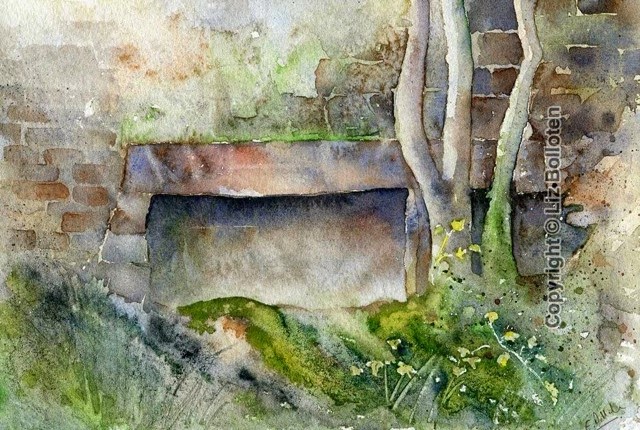
I had the very real pleasure of visiting Plas Brynkir earlier this year. I had already put together some watercolours of the site, and when there was opportunity to visit, I jumped at it. Just experiencing it in all its faded grandeur inspired me further. Two important books are out this year. Mark Baker's book: Y plas (on the Welsh Country House) and Timothy James book: Crumbling Historic Houses. These books are very relevant in drawing attention to what is our heritage, and history, and if these sites are lost forever, we ourselves are diminished. As for me I am always looking for excuses to paint old buildings and would welcome opportunities to do so. I feel a great need to record their beauty as a historic reference: that they were indeed here and have absorbing stories to tell.

 These beautiful paintings are available from Love My Wales as postcards for £2.50 and as prints ordered from Liz directly for £30 plus £5 postage. Originals are £250 each
 

Thursday, 14 November 2013

Four Elms, Adamsdown- A restored building at risk


An interesting project has recently come to a close at Four Elms, a Grade II listed school building in Adamstown, Cardiff. The redevelopment of this beautiful building was undertaken by NoFit State, a 27 year old circus company. The redevelopment of this beautiful building was to facilitate NoFit State’s venue on a permanent basis.

Four Elms was originally built by the United Methodist Church and was opened on 5th September 1896 and was owned by the church until 1978 when it was sold to the Cardiff County Borough Council, it later became nearly derelict and at risk. Then wonderful news came for Four Elms when No Fit State stumbled upon it in 2007, who started to look into the possibilities of acquiring it from the Cardiff County Council. It was then awarded by a long lease, then with the help of funders such as the Big Lottery Fund, Garfield Weston Foundation and Admiral Insurance, have restored it to a fully functional, entertaining and a fulfilling community venue. This is exactly the sort of thing that Love My Wales encourages and to them we say “well done!”

“For me this is an amazing regeneration project.  I love the fact that it is actually going to belong to people and not just a private firm.  Making something really beautiful from a building that has been so neglected.”
- Zoe Munn, Four Elms Development Officer

If you would like to see more from NoFit State, please visit their website: www.nofitstate.org

Monday, 9 September 2013

Day 20

At last the 30th is here, the day of the big open day! We didn't know what to expect today, but it was a great success! We started off by having the BBC here who did a live broadcast for Radio 1 to advertise the Open Day. It was a great help as we had over 60 people come from the local area! A lot came with their own memories of the site and varying age groups, which is always nice to see. We had lots of interest in our pull up displays which I am very pleased with as I put a lot of effort into them. The students couldn't be split into groups like before so it was all very casual with tours, luckily we had the help of Megan, a local girl who offered to do the welsh tours for us. This was very handy as we had a lot of Welsh speakers come to the open day. I feel it went very well and everyone got a tour. We were also visited by a local woman who had photographs of the Lower House from 1990, it serves as a good document of how the site has degraded over the last 20 years, so we were glad to have them.

Day 19

The students really felt the burn today. Lots of things to do on what is technically their last day. Some again were cleaning finds and others were recording their trenches and filling in the completed ones for next year. There's lots to do though and I think it might have to run into tomorrow's open day. This would be unideal but on the other hand, it is nice for the visitors to see what work goes on at an archaeological dig. Antonia Dewhurst also came today to give a talk about her photography and art projects that she has going on. I really liked the talk as I myself am really into the technical aspects of photography.

We all then went to Aberdunant to enjoy an end of dig meal, Antonia also came along! Aberdunant was actually where the last Brynker, Jane Brynker died in 1760. So its a very relevant place to eat!